
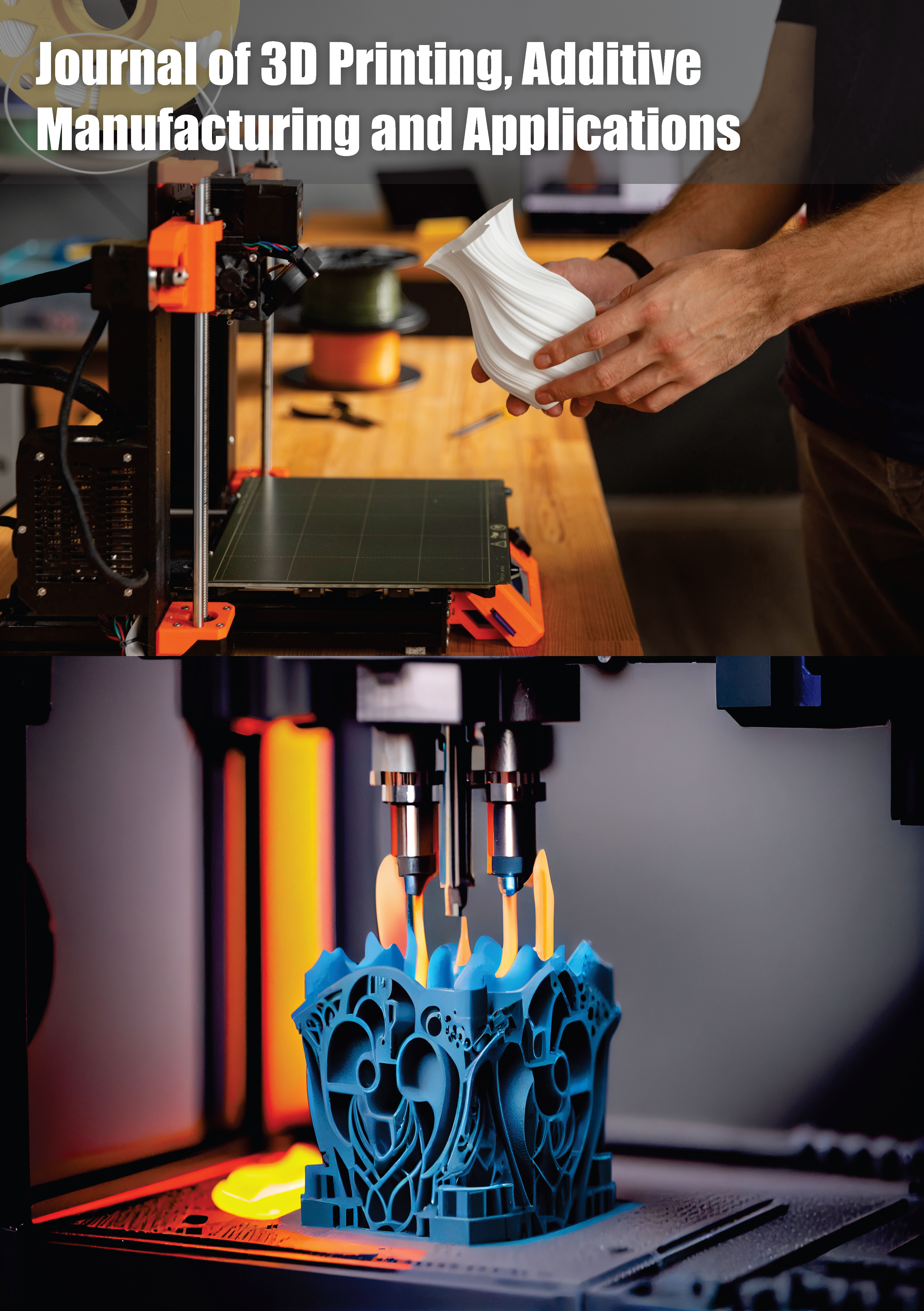
Journal of 3D Printing, Additive Manufacturing and Applications

Aim and Scope
The Journal of 3D Printing, Additive Manufacturing and Applications publishes original research, applied engineering studies, reviews, and case reports that examine the technologies, materials, processes, and uses of additive manufacturing. It aims to connect developments in research and industry with practical manufacturing needs.
Its scope reflects the rapid evolution of 3D printing, which is reshaping how products are designed, produced, and distributed. The journal encourages work that demonstrates technical advances, process improvements, or novel applications of additive manufacturing in diverse contexts.
Key areas of interest include:
- Additive Manufacturing Processes: Fused deposition modelling, stereolithography, selective laser sintering, electron beam melting, binder jetting, and hybrid manufacturing methods.
- Materials for 3D Printing: Polymers, metals, ceramics, composites, bio-based materials, and functional materials with tailored properties.
- Design and Modelling: Computer-aided design (CAD), generative design, topology optimisation, and simulation tools for predicting print outcomes.
- Process Control and Optimisation: Parameter selection, defect reduction, dimensional accuracy improvement, and post-processing methods.
- Medical and Bioprinting Applications: Custom implants, prosthetics, surgical models, tissue scaffolds, and drug delivery systems.
- Industrial and Engineering Applications: Aerospace, automotive, energy, and construction-scale additive manufacturing.
- Sustainability and Recycling: Use of recycled materials, energy-efficient printing, and lifecycle analysis of printed products.
- Testing and Quality Assurance: Mechanical testing, non-destructive evaluation, and standardisation of printed parts.
- Education and Skills Development: Training methods, curriculum integration, and workforce preparation for additive manufacturing careers.
The journal accepts both experimental and theoretical research, as well as applied studies and practical demonstrations. Submissions from various sectors and geographic regions are encouraged, with particular interest in research that addresses cost-effectiveness, scalability, and environmental impact.
Authors are expected to clearly state research objectives, describe the methodology, and explain the relevance of their findings to both technical and practical considerations in additive manufacturing.